
Most businesses think of advertising as something that happens on a screen.
Search ads, map listings, reviews, social posts, retargeting, email, and a website all compete for attention. Their job is to turn interest into a call, visit, booking, quote request, or sale.
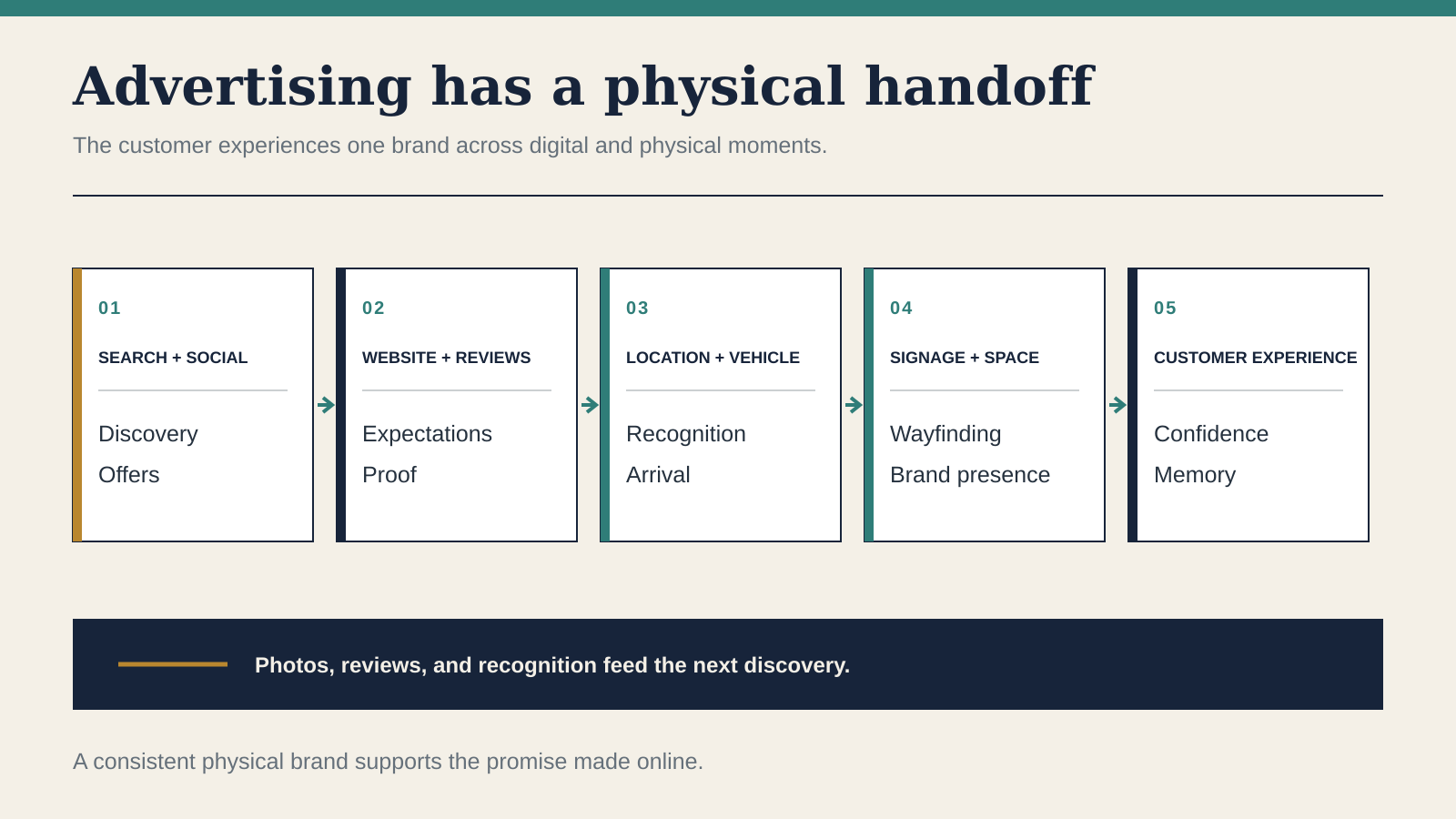
For a business with a physical presence, the brand does not stop when someone clicks. It appears on the building, front door, lobby wall, service vehicle, parking entrance, and every location a customer visits. The sign is where an advertising promise becomes something people can see in the real world.
That makes custom business signage part of the advertising system, whether a company operates one storefront or manages locations across several markets.
Advertising has a physical handoff
A customer may discover an HVAC company through Google, compare reviews, visit the website, and check its service area. The next impression may come from a branded truck in a neighbor's driveway or the sign outside the company's office.
A restaurant guest may see a social post, open the menu, and make a reservation. The storefront sign confirms the destination and sets an expectation before the guest reaches the door.
The same handoff happens in retail, medical offices, fitness studios, salons, professional services, and other businesses with customer-facing locations.
If the digital brand looks polished but the physical location looks temporary or unclear, the customer feels the gap. Advertising earned the attention, but the real-world brand did not fully support it.
A sign cannot guarantee trust or a sale. It can remove avoidable doubt.
The sign is often the first real-world ad
Paid media stops when the budget stops. Social posts move down the feed. Email gets buried. A business sign stays visible.
For a storefront, the exterior sign may introduce the business to passing traffic. For a contractor, the familiar visual may be a service vehicle. For a medical office, it may be the monument sign at the entrance. Inside an office or restaurant, dimensional lettering or a lobby sign can carry the brand into the customer experience.
This does not make signage a replacement for digital advertising. It gives the campaign a physical anchor after search, social, reviews, or referrals have done their part.
That anchor matters because customers experience one company, not a stack of channels. They remember whether the name, colors, message, and level of care felt consistent.
Custom signs should support the advertising promise
The wrong starting point is to treat signage as a disconnected production order.
A business may advertise premium service, speed, technical expertise, neighborhood familiarity, or a calm professional experience. The sign should support that position. A luxury dental practice should not make the same visual choices as an auto repair shop, and a family restaurant should not look like a corporate medical office.
Before production, the owner or marketing team should ask:
- Can people read the business name from the distance where they will actually see it?
- Does the sign work from the road, parking lot, sidewalk, entrance, or lobby?
- Does it match the website, vehicles, uniforms, and printed materials?
- Will it remain visible in the lighting conditions that matter?
- Does the material and finish fit the brand position and location?
- Will the sign still look credible in map photos, customer posts, and hiring content?
These are advertising questions with production consequences.
One location can improvise; several locations need a system
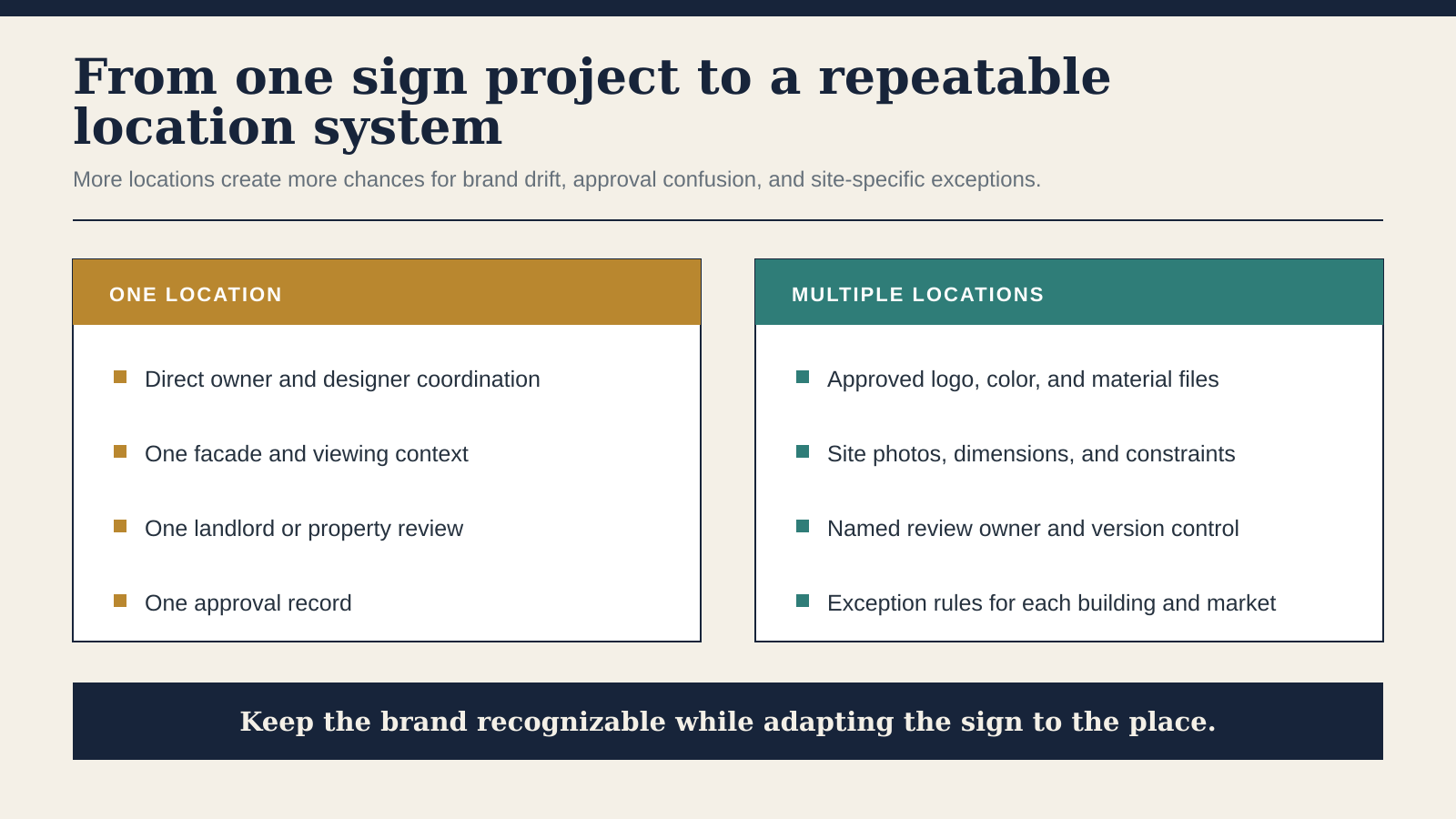
A single-location business can often solve signage decisions through direct conversations among the owner, designer, landlord, and sign provider. The process becomes harder when several locations are involved.
Different buildings have different facades, sightlines, landlord rules, and local requirements. At the same time, the brand still needs to look like the same company in every market.
A multi-location team needs a repeatable planning process. That usually means defining approved logo use, colors, materials, illumination preferences, size ranges, placement rules, review ownership, and the exceptions each site may require. The goal is not to make every building identical. It is to keep the brand recognizable while adapting the sign to the location.
This is where signage becomes both an advertising asset and an operating discipline. Without clear approvals, teams lose time to version confusion, inconsistent quotes, late design changes, and signs that drift from the brand standards used in paid and owned media.
Visual planning catches problems before production
A flat logo file does not show how a sign will work on brick, glass, stone, metal, or a wide storefront. It does not show what happens at night, what the customer sees from the road, or whether a detailed logo can be fabricated cleanly at the required size.
Visual mockups help the buyer and sign provider discuss the same thing. They can reveal that a sign feels too small, lacks contrast, sits awkwardly on the facade, or uses details that will not translate well into the chosen sign type.
Signage.com develops custom business signs through an online quote and visual-planning workflow that helps business buyers move from a logo and location context toward a clearer signage discussion. Its Design Studio can help a buyer explore how a sign concept may look before final production decisions are made.
The distinction matters: a visual concept supports planning and conversation. It is not a substitute for final measurements, engineering, code, permit, electrical, structural, or installation review where those requirements apply.
Consistency should survive the handoff
Many brand problems appear between approval and execution.
The marketing team approves one version. A location manager sends an older logo. A vendor substitutes a material. A landlord requires a smaller sign. A second location orders from a different file. None of these decisions feels dramatic on its own, but the result is visible inconsistency.
A better process keeps the advertising and signage teams connected. The approved files, sign type, dimensions, colors, finish, illumination, mounting approach, and location-specific constraints should be recorded before the order moves forward. For several locations, each site should have a clear approval record rather than relying on email memory.
The more valuable the brand, the less sense it makes to leave its most visible physical asset to guesswork.
Signage supports the local proof loop
A customer sees an ad, reads reviews, visits the website, notices a vehicle, and arrives at the location. Each impression can add confidence or introduce hesitation.
The sign is one part of that loop. It can confirm that the customer has found the right place, make the business easier to recognize later, and keep the physical presence consistent with the promise made online.
For businesses selling considered services, those small cues carry more weight. A person choosing a medical office, contractor, professional adviser, or commercial supplier is looking for signs that the business is established and attentive. Clear, appropriate signage helps support that judgment without making claims it cannot prove.
The advertising plan should include the physical brand
Signage deserves a place in campaign planning before a new location opens, a rebrand launches, or a multi-location rollout begins.
The media plan determines how people will hear about the business. The signage plan determines what they will see when the brand becomes physical. When those decisions happen together, the website, ads, vehicles, storefront, lobby, and location photos reinforce the same identity.
When they happen separately, the advertising team has to work harder to overcome inconsistencies that customers can see for themselves.
A custom business sign is manufactured, but it is still a brand message. For businesses with physical locations, it may be the most persistent advertising message they own.